Posts

Showing posts with the label Hobbies

Orange Impatiens

Image
Beautiful flowers in the gardens at Mahableshwar. Rain-drenched, refreshing orange petals.... Would love to know what these flowers are called..If anybody can enlighten me, please oblige! :) Revel in the varied shades of the vibrant orange at  here

Ek Cutting Chai

Image
The most refreshing beverage I know Tea aka Cutting Chai. Served in short glasses at small stalls around Indian street corners, it's the most refreshing with a hint of Masala or Ginger added to it. You are to sip on this milky brew it, slowly, very slowly. And have the Aaahaaa experience!  Kadak!!! To sample the world's favourite beverages visit here

Soaking in the rain..

Image
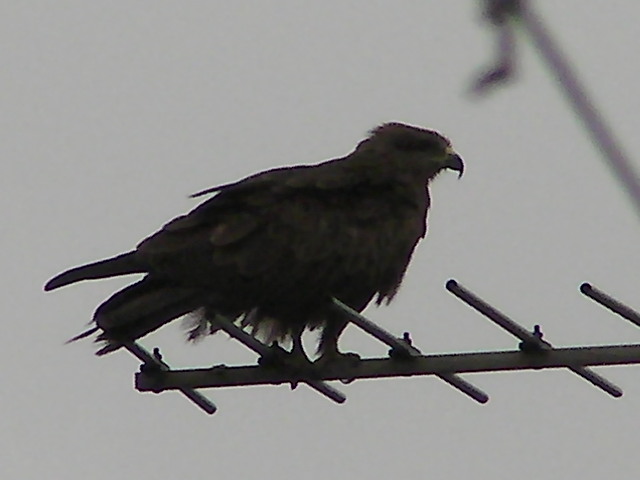
My heart went out to these big and little birdys soaked to their bones in the rains. With heavy feathers they were desperately searching for a safe and sheltered perch which is sadly rare in the cities now. :( The Black Kite (Milvus migrans) The Common Tailorbird ( Orthotomus sutorius) Scaly-Breasted Munia (Lonchura punctulata) The Oriental Magpie Robin (Copsychus saularis)

Nat Geo Moment Awards 2010

Image
HI, Check out my entries for the Nat Geo Moment Awards 2010.. This is the first time I'll be participating in a photography contest outside College premises..And am happy to tell you that all my uploaded entries were approved for the contest :D So express your love for photography and do shower my entries with kind appreciation and votes! Just click at the top right or bottom right hand corner of the Nat Geo window to flip the page to the next photograph or entry.

Two in the bush....

Image
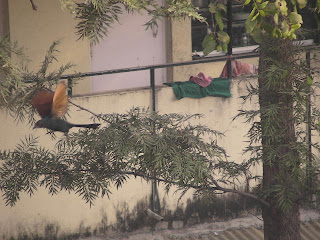
  The Oriental Magpie Robin ( Copsychus saularis ) ...has made my day! Spotted it early this morning on our garden fence.  This distinctive black and white bird holds its long tail upright as it forages on the ground and its perch.  This passerine bird is native to tropical South and South East Asia. It was considered a member of the thrush family but is now classified as an Old world Flycatcher. Wish My lens had a bigger zoom to capture a perfect pic' of this restless bird. Here we see The Asian Koel - Male ( Eudynamys scolopaceus.. we know this fellow better as the cuckoo since it belongs to the order of the Cuculiformes. At 45 cms, this big bird is again native to South & South East Asia and China. It is famous for encroaching into the Crow's nest for laying its eggs and the young ones are raised by the gullible foster parents. Such birds are known as the brood parasites. The word koel is echoic in origin and the bird is a widely used symbol in Indian p...

Bird on a wire

Image
   This is the Red Cheeked/ Red Whiskered Bulbul ( Pycnonotus jocosus ) , measuring about 20cms. This bird can be easily identified by its brown crest, red cheeks and red vent. This bulbul is native to India and is generally seen in the woodlands or in the countryside. That's how I spotted this lone bird, sitting peacefully on a wire at Pratapgarh, while the guide was pointing to a small look-out window in th e wall of the fort. My imagination must have been going wild because I felt like it was staring away into the distance, meditatively. As if it was pondering on the history of the fort, too! This bird feeds on a variety of fruits, insects and flower buds, and often does so in flocks of three to fifty birds.  According to most authorities there are 144 species of Bulbuls, Greenbuls and allies in the family Pycnonotidae and I have spotted only 2 of them as yet?! :(  

Vintage Stamps

Image
My Pa is still an avid stamp collector but sadly its a rarity to be able to lay your hand on a good stamp (unless you go and buy them yourself)due to this E-mail era ! The huge albums full of international stamps was just an inheritance to me until a few days ago, since childhood. However since I recognised  that bird printed on the face of a stamp. It was the Eurasian Golden Oriole that I'd spotted on the branches of the tree in my garden! You can check the photo' out, again, here . Its thrilling to know that I own a vintage stamp of Hungary on its fauna, that I've managed to see in our very own city, Pune! This is the 40filler with the   Eurasian Golden Oriole ( Oriolus oriolus)  Another interesting Vintage Hungarian stamp has the Kentish Plover ( Charadrius alexandrinus).  Will I spot this bird too some day? I also wish to progress from just simple stamp collection to informed Philately. Anyone who can guide me with this is most welcome to share some tips an...

Birds of prey!

Image
This post has been altered on 2nd March after a valuable feedback from another blogger. At first we, Dr. Ajay Pradhan & I believed that this bird I'd spotted is the  The Red-necked Falcon or Red-headed Merlin (Falco chicquera). However, a kind reader and fellow-blogger Thomas , whose a veteran nature enthusiast, pointed out that we were mistaken. This bird here is in fact the Shikra  (adult male) and not the Turumti! As of now I'm extremely thrilled to have spotted a bird of prey. And I have actually also been able to click a fantastic picture within its brief moment of perch. WOW!! Isn't this a price catch of sorts? " Just look at the details..the red eye..super Vibhuti!" were the words of praise from Ajay! The  Shikra or The Little Banded Goshawk ( Accipiter badius ) is a small bird of prey in the family Accipitridae, which also includes many other diurnal raptors like the eagle, buzzard and the harrier. This bird is a small raptor (26–30cm long), a...

The Jungle Babbler

Image
Again as identified by  Dr. Ajay Pradhan this bird my lens captured is The Jungle Babbler , Turdoides striata, a gregarious bird found mostly in South-Asia . An interesting feature about this bird is that it usually forages in a group of 6-7 birds and hence has acquired its Hindi nickname 'SaatBhai' or 7 brothers.... The Jungle babbler  is a non-migratory bird and has a harsh nasal call...Read more about the bird at Wikipedia. My observation is that its grey-brown body helps it camouflage in the urban surroundings and the trees but its noisy habit of  mewing calls, continual chattering, squeaking and chirping keeps it from being inconspicuous...

The early birds

Image
The Purple Sunbird , Cinnyris asiaticus , is a very small old world passerine bird that feeds mainly on nectar. Less than 10cm long the most prominent feature of this bird is its down-curve bill with brush-tipped tubular tongue.The species is distributed widely from the Persian Gulf through South Asia and into Southeast Asia. They are resident birds in most parts of India distributed over the east of the desert region and south of the Himalayas.  The Indian Grey Hornbill ( Ocyceros birostris ) is a common hornbill found on the Indian subcontinent , one of the few hornbill species found within urban areas in many cities where they are able to make use of large avenue trees. About 24 inches long, the call is a squealing call. Mostly spotted in pairs, their flight is heavy and gliding. The Great Tit ( Parus major ) a passerine bird of the Tit family, is a widespread species of temperate Europe & Asia. The great Tit does not usually migrate.14cms in size this bird has a variet...

Some more Birding..

Image
Only these 2 can give me precise info about the birds I’ve recently spotted through my camera lens, Dr. Ajay Pradhan & Wikipedia.  And this is what I’ve learnt the second time around… The Greater Coucal or the Crow Pheasant ( Centropus sinensis ) is a non-parasitic member of the cuckoo order,  the Cuculiformes. It is a widespread resident in India . The Coucal or the Crow Pheasant is colloquially referred to as the Bharadwaj bird or Kumbhar kaola in Marathi.  There are mainly too varieties- The Greater & the Lesser, informs Dr. Ajay  and what I’ve clicked here is the Greater Coucal. It is considered lucky to have spotted one! With a purplish black body and rust coloured wings it is a large bird at 48 cm. The play of sunlight on its wings when in flight makes it appear golden! An extremely handsome bird it is. This pair is the Eurasian Golden Oriole (Oriolus Oriolus). As the name clearly suggests, these birds are found in Europe and Asia except for t...

Watch & Learn!

Image
I was suggested by my feature editor to do a story on migratory birds in Pune this winter. Being completely ignorant about our avian friends I owned up and almost immediately declined. The story was taken up by a more knowledgeable pen later but I was left thinking! How could I have missed out? I came home to peek out my terrace only to be even more bewildered by the blind eye Id turned towards the beauty around. The garden facing my flat, rich in flora & foliage was also being visited by a whole lot of interesting feathered friends. My friend, the ever-obliging Dr. Ajay Pradhan who’s an avid bird-watcher also came to my rescue and helped me recognize the birds by their names. He started updating me on the basics of bird-watching, “ Just watch them patiently and carefully and you’ll see there’s so much to learn he says!” So this is what I saw ….   The adult Ashy Drongo (Corvidae Dicrurini)  breeds in central India and also along the Himalayas . “Next time u see this...